
Top 25 HR Interview Questions for Freshers With Sample Answers
Why HR interviewers ask what they ask, answers you can adapt to your own story, and the replies that quietly cost freshers their offers.
Short answer: The HR interview for freshers checks communication, motivation, honesty and fit, not technical knowledge. The most common questions are "Tell me about yourself", "Why should we hire you?", "What are your strengths and weaknesses?", "Why this company?" and "Where do you see yourself in five years?", plus behavioural questions about challenges, teamwork and failure. Prepare a 60–90 second introduction, six real stories in the STAR format, and honest answers on relocation, bonds, salary and higher studies. That covers almost every question below.
Key takeaways
- HR questions are predictable. Most interviews draw from the same 25 or so questions.
- Behind every question there are only three real checks: Can you communicate? Will you stay and grow? Are you honest?
- Prepare six stories, not 25 answers. One good story can answer five different questions.
- Never lie about backlogs, gaps or other offers. HR verifies, and dishonesty ends the process faster than any weak answer.
- The samples below show structure. Replace every detail with your own, because interviewers recognise copied answers.
How to use the sample answers
Each question below has three parts: why they ask, a sample answer written for a typical final-year B.Tech student, and what to avoid. Treat the samples as templates. Keep the structure and swap in your own college, projects, numbers and reasons.
Two frameworks do most of the work.
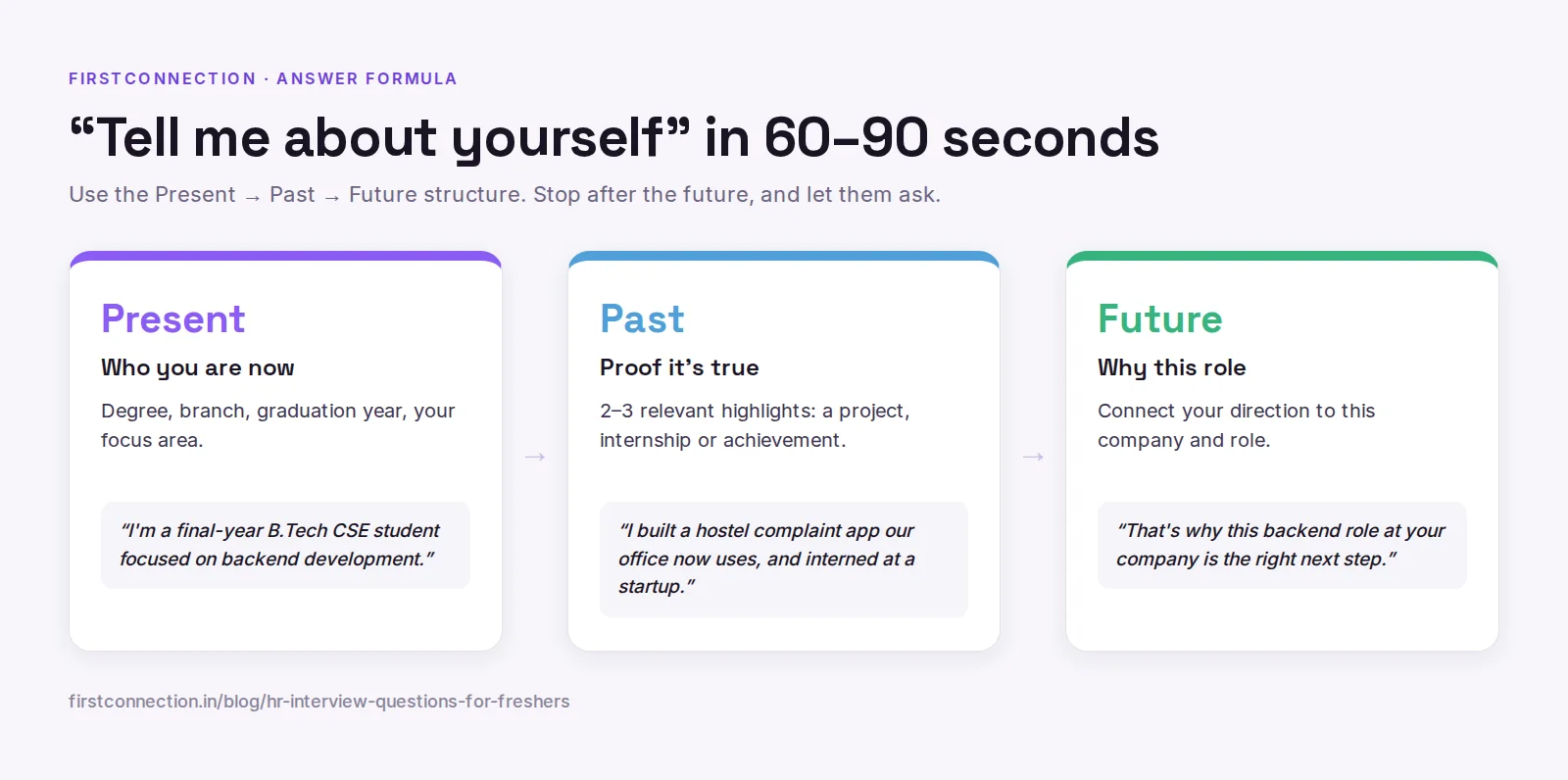
Present–Past–Future works for introductions and "walk me through your resume": who you are today, what you've done that's relevant, and why this role comes next.
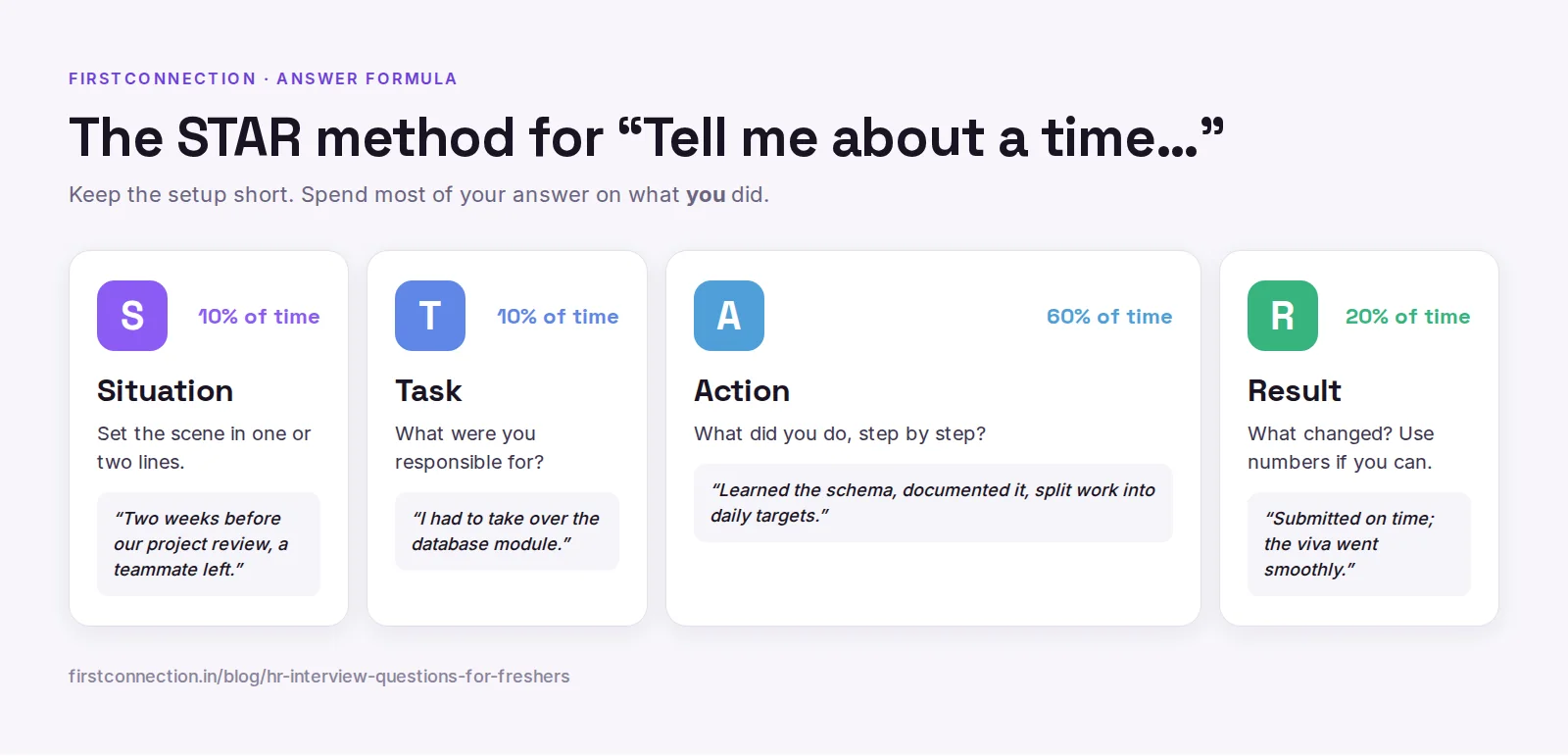
STAR (Situation, Task, Action, Result) works for every "Tell me about a time…" question. Keep the situation short and spend most of the time on your action and the result.
Part 1: Questions about you
1. Tell me about yourself.
Why they ask: It is a warm-up, a communication check and a test of whether you can be relevant and concise.
Sample answer: "I'm a final-year B.Tech Computer Science student at [College], graduating in 2026 with a CGPA of 7.8. Over the last two years I've focused on backend development. My main project is a hostel complaint-tracking app built with Node.js and MySQL, which our hostel office now uses, and I interned for two months at a Pune startup building REST APIs. I enjoy turning messy real-world processes into simple software, and that's why this backend developer role at [Company] interests me: it's exactly the kind of work I want to grow in."
Avoid: Reciting your resume line by line, starting from Class 10, or sharing family details unless asked.
2. What are your strengths?
Why they ask: To see whether you know yourself and can back claims with evidence.
Sample answer: "My biggest strength is persistence with problems. During my final-year project, our app crashed under multiple logins, and I spent three days tracing it to a database-connection issue before fixing it with connection pooling. I'm also a quick learner: I picked up React in about three weeks for my internship because the project needed it."
Avoid: A list of adjectives ("hardworking, honest, team player") with no proof.
3. What is your greatest weakness?
Why they ask: To test self-awareness and honesty, and whether you are working on it.
Sample answer: "I used to hesitate to speak up in group discussions, even when I had a good idea. Last year I joined our college's technical club and volunteered to present at two workshops. It's much better now, though I still prepare notes before big meetings to stay structured."
Avoid: Fake weaknesses ("I'm a perfectionist", "I work too hard") or a weakness that is core to the job.
4. Walk me through your resume.
Why they ask: To check consistency and see what you consider important.
Sample answer: Use Present–Past–Future, as in Question 1, but anchor it to the resume sections: education → key project → internship or achievement → why you are applying. Keep it under two minutes and pause after each section so the interviewer can stop you.
Avoid: Mentioning anything you can't explain in detail. Everything on the resume can be questioned.
5. Why did you choose your branch?
Why they ask: To understand your motivation and decision-making.
Sample answer: "Honestly, in Class 12 I chose Computer Science because I enjoyed the programming we did in school. What kept me interested was building my first working website in the second year. Seeing something I made actually being used made me sure this was the right field."
Avoid: "My parents told me to" with nothing more. If that is part of the truth, say what made you stay.
6. How would your friends or professors describe you?
Why they ask: A softer way to check your self-awareness and how you work with others.
Sample answer: "My project guide would probably say I'm dependable, because I've never missed a project deadline, and my friends would say I'm the person they come to when code won't compile. They'd also tease me about planning everything in spreadsheets."
Avoid: Traits that contradict how you're coming across in the interview.
Part 2: Motivation and the company
7. Why do you want to join our company?
Why they ask: To see whether you've researched them or are applying everywhere.
Sample answer: "Three reasons. First, your structured training program for freshers. I want a strong foundation before I specialise. Second, you work with clients in banking and healthcare, and I'd like exposure to large, real systems. Third, I spoke with a senior from my college who joined last year, and she said freshers get real project work within the first few months."
Avoid: "It's a big company" or "for the salary". Name specific reasons.
8. What do you know about our company?
Why they ask: A direct test of preparation.
Sample answer: Cover what they do, who their customers are, one recent development (a product launch, an expansion or a major client) and how your role fits in. Thirty minutes on their website, recent news and LinkedIn page is enough.
Avoid: Reading out the founding year and headcount like a Wikipedia summary.
9. Why should we hire you?
Why they ask: To give you the chance to connect your skills to their needs.
Sample answer: "The role needs strong Java fundamentals, SQL and the ability to learn quickly. I've used Java and MySQL in two full projects, cleared [certification or assessment], and in my internship I learned a new framework and shipped my first feature within three weeks. Beyond skills, I take ownership. If I commit to something, it gets done."
Avoid: Comparing yourself to other candidates or sounding desperate.
10. Where do you see yourself in five years?
Why they ask: To check ambition, realism and whether you're likely to stay.
Sample answer: "In five years I'd like to be a strong backend engineer who has worked on large production systems, and ideally leading a small module or mentoring new joiners. I'm less focused on a title and more on becoming someone the team relies on for complex problems."
Avoid: "In your chair", "running my own startup", or plans that clearly mean leaving soon.
11. Why software, when your branch is ECE, EE or Mechanical?
Why they ask: To check that the switch is a real decision, not a fallback.
Sample answer: "In my second year, I used Python for a signal-processing assignment and enjoyed the coding more than the hardware part. Since then I've completed a DSA course, built two web projects and solved over 150 coding problems. My ECE background actually helps me understand how software interacts with hardware, which I see as an advantage."
Avoid: "There are no jobs in my core field". Show the proof of your interest.
Part 3: Behavioural questions (use STAR)
12. Tell me about a challenge you faced and how you handled it.
Sample answer: "Situation: Two weeks before our final-year project review, our teammate who handled the database left the team. Task: I had to take over a part I hadn't built. Action: I spent two evenings understanding the schema, documented it and split the remaining work into daily targets for the three of us. Result: We submitted on time, and the documentation I wrote made our viva much smoother."
13. Describe a time you worked in a team, or handled a disagreement in a team.
Sample answer: "In a hackathon, two of us disagreed about whether to build a mobile app or a web app. Instead of arguing, I suggested we each spend 20 minutes listing what we could finish in 24 hours. The web app was clearly faster, so we went with it, and my teammate led the UI. We reached the final round, and the decision process actually brought us closer as a team."
Avoid: Stories where you were right and everyone else was wrong.
14. Tell me about a time you failed.
Sample answer: "In my third year, I applied for an internship and cleared the coding test but was rejected in the technical interview because I couldn't explain my own project's database design. It stung, but it was fair. I rebuilt that module myself, and since then I make sure I can explain every line on my resume. In my next interview, I got the internship."
Avoid: A 'failure' that's actually a boast, or blaming others.
15. Tell me about a time you showed leadership.
Sample answer: "I coordinated our department's technical fest with a team of 12 volunteers. When registrations were low a week before the event, I split the team to visit classrooms and post in college WhatsApp groups, and we nearly doubled registrations in five days. I learned that leadership is mostly about clear roles and following up."
16. How do you handle pressure and tight deadlines?
Sample answer: "I break the work into small daily targets and do the hardest part first. During my end-semester exams, I also had an internship deliverable due. I planned each day in advance, told my manager early about my exam dates, and delivered the feature one day before the deadline."
17. Tell me about an achievement you're proud of.
Sample answer: Choose something that shows initiative and effort, ideally related to the job: a project people actually use, a competition result, a skill you built from zero. Explain why it mattered to you, not just what the result was.
18. How do you learn a new skill or technology quickly?
Sample answer: "I start with the official documentation and a short course to get the basics, then build something small immediately, because I learn fastest by breaking things. When I learned Git, I set up a repository for my mini-project on day one and made mistakes there instead of on a team project."
Part 4: Practical and tricky questions
19. Are you willing to relocate or work in shifts?
Why they ask: Large employers place freshers across cities and projects.
Sample answer: "Yes, I'm open to relocating. I see it as part of starting my career. If there's flexibility, I'd prefer [City], but it won't affect my decision." Answer honestly: if you genuinely can't relocate, say so now rather than declining the offer later.
20. Are you comfortable signing a service agreement or bond?
Why they ask: Some companies invest in long training periods and ask for a minimum commitment.
Sample answer: "Yes. I understand the company invests in training freshers, and I'm planning to build my career here for the long term anyway. Could you share the duration and terms so I'm clear on them?"
Avoid: Agreeing without understanding the terms. Always read the bond clause in your offer letter.
21. What are your salary expectations?
Why they ask: For campus roles the package is usually fixed. They are checking whether you're realistic and focused on the right things.
Sample answer: "As a fresher, my priority is learning and good project exposure. I'm comfortable with the package offered for this role in the campus process."
Avoid: Quoting a number far above the announced package, or saying "anything is fine" in an off-campus interview where you should have a researched range.
22. Do you have other offers? Would you leave if you got a better one?
Why they ask: To gauge commitment and honesty.
Sample answer: "I have [an offer from X / no other offers yet]. I'm interviewing here because this role matches what I want to do, and if selected, I intend to join and stay."
Avoid: Inventing offers to create pressure. Placement cells and HR teams talk to each other.
23. Why do you have a backlog or a gap in your education?
Why they ask: To see how you handle setbacks and whether you're transparent.
Sample answer: "I had a backlog in Engineering Mathematics in my second semester because I underestimated the subject. I cleared it in the next attempt and changed how I study. My CGPA has improved every year since."
Avoid: Hiding it. Your marksheets will show it anyway.
Part 5: Closing questions
24. Are you planning to pursue an MBA or MS?
Why they ask: They don't want to train someone who will leave in a year.
Sample answer: "Not in the near future. I want to spend the next few years building strong industry experience. If I study further later, it will be because it helps me grow in this career, and companies often support that for long-term employees."
Avoid: Lying if you have firm admission plans. Being honest is better than reneging later.
25. Do you have any questions for us?
Why they ask: Thoughtful questions signal genuine interest.
Good questions to ask:
- "What does the training program for freshers look like, and how are projects allocated?"
- "What would make someone successful in this role in the first six months?"
- "What technologies does the team I might join work with?"
Avoid: "No questions", or asking about leave and salary hikes as your first question.
Your six-story bank: prepare once, answer twenty questions
Most behavioural questions are variations of six themes. Write one STAR story for each, using real events from your college life, projects, internships, fests, sports or part-time work:
Common HR round mistakes that cost freshers offers
- Contradicting your resume. If it says "proficient in Python", expect a follow-up.
- Speaking negatively about your college, faculty, an internship or a former team.
- Over-rehearsed answers that collapse when the question is rephrased.
- Not knowing the company you applied to.
- Dishonesty about backlogs, gaps, offers or higher-study plans.
- Weak body language online: looking away from the camera, a noisy background, or joining late.
For a broader view of where students go wrong during placement season, read 10 common mistakes students make during campus placements.
Practise your HR interview with FirstConnection
Reading answers is not the same as saying them under pressure.
- Rehearse with Interview Arena: practise HR and behavioural interviews with an AI interviewer and get a detailed Credo Report on your structure, clarity and confidence.
- Get a free resume audit on the FirstConnection candidates page so your resume and your interview answers tell the same story.
- Talk to a recruiter directly with DTR Connect and ask what they listen for in an HR round.
Practise your HR interview in Interview Arena →